jewellery from scrap steel and precious materials
in time of daffodils (who know
the goal of living is to grow)
forgetting why, remember how...
e.e. cummings
I have always enjoyed daffodils. There is something cheering about the
bright splashes of yellow adorning motorway embankments and poking
through the muddy late-winter snows in the most unexpected of places.
The daffodil – Narcissus pseudonarcissus – is a native of the UK and is
found across Europe in 54 different species and countless cultivars.
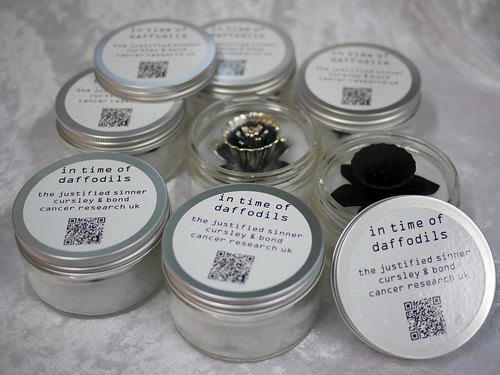
My installation for Cursley and Bond consists of 7 medical jars, each
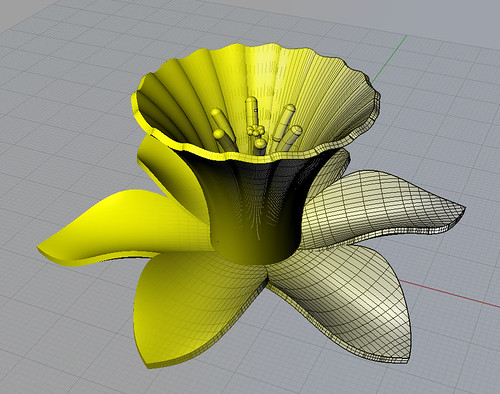
containing a daffodil brooch. Each brooch is made from the same 3D
model of a daffodil which I created in the modelling software, Rhino.
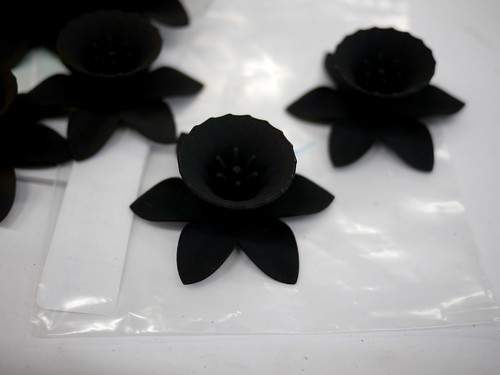
Six of the daffodils are “perfect” 3D prints of the model in black
plastic and the seventh is a sterling silver version, entirely
hand-made from the same pattern. My idea for the project came from the
notion that cancerous cells are merely versions of the original perfect
human cell. Starting with an ur-daffodil – the digital model – I
created variations, the plastic prints being not only identical but
also the closest to the original:
and the hand-made silver flower
being the erroneous one, the one which bears the marks of mutation.
In a volte-face manoeuvre, the erroneous flower becomes the most
interesting, the most beautiful, the most valuable.
However you read it,
these daffodils can save lives. Neither I nor Cursley & Bond are
taking any money from these flowers and the entirety of the money
raised goes to Cancer Research UK.
http://www.cancerresearchuk.org/
http://en.wikipedia.org/wiki/Narcissus_(plant)
(Links open in a new window.)
Care of your brooch:
Plastic Prints
If you have a black
plastic brooch, please note that although it will not be damaged by
water, it is porous and can absorb liquids. You should avoid allowing
it to come into contact with oils or fats which will stain it. If it
gets wet, allow it to air-dry. You can use a soft brush on the
surface to remove dust and it can be washed in warm, soapy water.
The plastic colour
will change over time, mellowing to a rich purplish hue.
The pins on the back
of these brooches are sterling silver and can be cleaned with a soft
brush and bicarbonate of soda.
Sterling Silver
The sterling silver
brooch is patinated to a soft blackened surface. It is set with a
natural mandarin garnet. To keep the polished surfaces tarnish-free,
wear the brooch as often as possible and clean the surface with
bicarbonate of soda on a soft cloth or brush. Wash with warm water
and detergent and dry with a lint-free cloth.
other pieces to view on flickr